Do you struggle with imposter syndrome?
FYI, you’re not the only one!
Even after many years of running my business, there are still days when I ask myself this simple question: “Who am I to be doing this?”
If you are reading this and wondering if you have what it takes to succeed in business, then chances are you are struggling with imposter syndrome. Hell, I’ve been running my own business for over 20 years now, and have helped hundreds, if not thousands of clients to get their business legally protected, but there are still many days where I feel like I don’t belong.
The problem, if you haven’t already guessed it, is something called imposter syndrome.
What is Imposter Syndrome (an why is it SO sneaky)?
According to the Oxford Dictionary (thanks Google), imposter syndrome is defined as: “the persistent inability to believe that one’s success is deserved or has been legitimately achieved as a result of one’s own efforts or skills.”
I had to read that a few times to let it resonate.
Basically, if you suffer from imposter syndrome (and I have yet to meet an entrepreneur that does NOT suffer from it), then you are constantly second-guessing yourself and you don’t feel like you belong or that you are deserving of success.
Put another way, you don’t feel like you are good enough.
Imposter syndrome can be soul-crushing for entrepreneurs who can’t get past their feelings of inadequacy. And it affects all sorts of entrepreneurs, regardless if you are a coach, consultant, service professional, or even a lawyer (like me). Chances are, if you are a high-achiever in business and in life, you likely suffer from imposter syndrome.
And if you are running an online business, your feelings of inadequacy can be amplified as you compare yourself to your competitors and live your life on social media.
What’s so crazy about imposter syndrome is that many of the people who struggle with it the most are incredibly successful. And it’s the fact that they still feel like a fraud despite mountains of evidence suggesting otherwise.
People who suffer from imposter syndrome frequently experience symptoms such as self-doubt, discounting their accomplishments and a generalized fear of being “found out”.
As a lawyer, I see this all the time both in my own life and in the lives of my colleagues. Lawyers are constantly striving for perfectionism, comparing themselves and their practices to their peers, and constantly worrying about potential malpractice claims or bar grievances.
How Imposter Syndrome Shows up for Online Entrepreneurs
See if you can relate to any of these struggles…
- You hesitate to launch a course or your next product because you just don’t think you are “ready enough”
- You are afraid to charge even modest prices for your products or services
- You are afraid of what people (including family and friends) will think of you, so you don’t promote your business online (I struggle with this a LOT)
- Worrying about whether you have the proper legal protections in place so that you can launch
Raise your hand if you can relate to at least one of these examples. 🙋♂️
My Personal Struggle with Imposter Syndrome
Since I transitioned my law practice to helping entrepreneurs over 10 years ago, I’ve created and sold hundreds of thousands of dollars worth of legal templates, I’ve run a successful YouTube channel to help online entrepreneurs and grown it to over 177,000 subscribers, and I’ve created a monthly membership program to help entrepreneurs get their legal house in order.
But this doesn’t change the fact that I am still worried about whether my law business will every be truly “successful”. (And what does success mean, anyway?)
Here are a few of the ways that imposter syndrome has manifested itself in my legal practice:
First, I’ve struggled throughout my career by comparing myself to other lawyers who had practices that I “perceived” were more successful than mine.
I’ve constantly questioned my fees or the value I deliver for my clients, even as I see other “more successful” lawyers that charge 2-3 times as much as I do for the same services.
I’ve considered taking a board certification exam to give myself more credibility in the market place (even though I don’t really need it).
I’ve even worried that when a really great, higher end client hires me that I’m just not good enough for them.
Why All This Matters (and What It’s Costing You)
You may be thinking to yourself, ok – this is all well and good, but why do I need to worry about this?
Because it is derailing your career and your business and taking away from your future.
Last year I separated from my wife and during the past 12 months I’ve thought long and hard about what I gave up by ending my marriage and conversely, what I gave up by marrying my spouse in the first place.
In general, I’m a pretty optimistic person, but my ex-wife constantly second-guessed me and my business ideas. As soon as I would get some traction with my business, she would do something to derail that. Frankly, I think a lot of this was her own insecurity feeding into my professional life.
But when I look back to when I first started my law firm in 2005, I thought the sky was the limit. Failure was not an option. I knew nothing (compared to what I know now), but I was fearless when it came to my business and I thought the sky was the limit for what I could accomplish.
As the years went by, and I became a better lawyer, I find it ironic that I became less confident in myself and my abilities as a business person.
So back to why this even matters.
When you begin to second-guess yourself, as I have many times before, you will start to lose out on miss opportunities.
You will get burned out as you attempt to over-deliver for all of your clients but refuse to hire help.
You will stay small because you are scared of what it means to take a risk and try to grow your business.
Which is why you need to start overcoming imposter syndrome with a mindset shift.
You don’t need to be 100% confident in yourself to take action.
How I’m Working to Overcome Imposter Syndrome
If anything that I’ve written so far is resonating with you, and you want to start taking steps to overcome your imposter syndrome, I’d like to offer you a few ideas and mindset tools that you can use to put yourself back on the right path.
1. Keep a “wins” folder of testimonials, kind messages, and major sales transactions
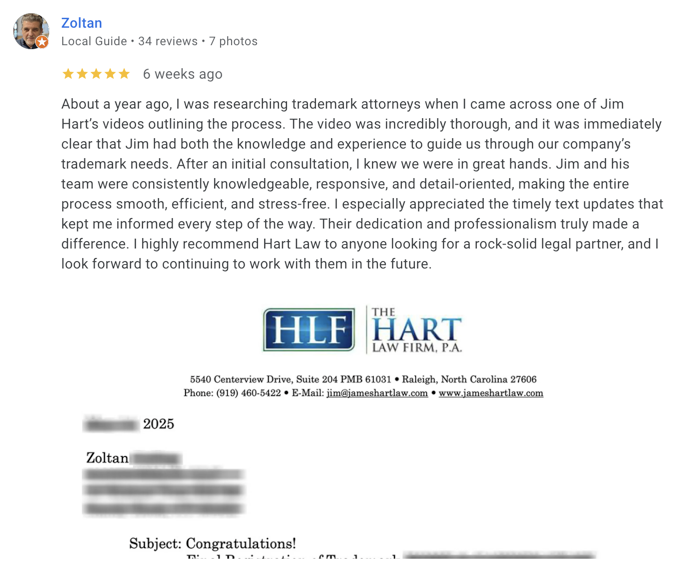
If I’m ever having a really bad day, I like to go back to the Google page for my law firm and read my client reviews. We don’t actively solicit reviews from clients, but rather let them come in organically. But when you get a review like this, it goes a long way towards validating the work I do.
2. Set small, achievable goals to build your confidence through action
Many years ago I read a book called “Action! Nothing Happens Until Something Moves” by Robert Ringer (affiliate link). The basic premise is that the difference between people who are successful in business and in life and those that aren’t is that the most successful people take regular action.
Writing this blog post is one example. Posting regular videos to my YouTube Channel is another example.
The more action you take in your business and in life, the more good things will happen to you.
3. Find Your Tribe
Reading this post is a great first step – but you need to get out and talk to other entrepreneurs. There are a ton of Facebook Groups and other communities where entrepreneurs hang out and talk about entrepreneurial stuff – including imposter syndrome.
Find those people and groups and get involved. Ask questions. Answer questions. Meet new people.
You will be amazed at what will happen if you take these small steps.
4. Get Legally Legit
Sometimes getting your legal house in order is all you need to do to feel better about your business. Whether that means setting up your LLC (here is a link to my preferred vendor), getting a proper contract in place for dealing with clients, or protecting your brand, a little legal protection can go a LONG way.
Bottom line – sometimes it is better to make imperfect progress than wait for everything to be perfect.
If You Have Imposter Syndrome, it Means You CARE About Your Business and Your Customers
I actually get a bit nervous when talking to entrepreneurs who aren’t worried that they are doing things correctly. While this is rare, it is a sure sign that they may not be taking their business seriously.
If you find yourself worrying about your business and whether you have what it takes to be successful, chances are you are serious about your busienss and you want to make sure you are doing things the right way, both for you AND your clients.
People suffering from imposter syndrome often are way more thoughtful and capable than they give themselves credit for. And when they show up for their business and their clientele – it shows… big time.
If you are looking up to an awazing business owner or entrepreneur, it is very likely that they felt they way you do at some point in their career as well (and likely they still do).
Final Thoughts on Imposter Syndrome
Remember, you are not alone in thinking that you aren’t good enough, and you are probably way better than you think. You are not a fraud and you ARE building an amazing a real business that will help lots of people.
I invite you to share your experience with imposter syndrome below in the comments.
And if you want to feel more legit and confident in your business, then having the right legal tools in place will definitely help. I invite you to check out our legal templates when you are ready to take the next step and get your business some legal protections.